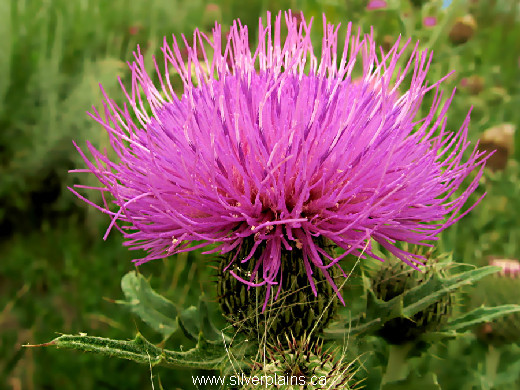
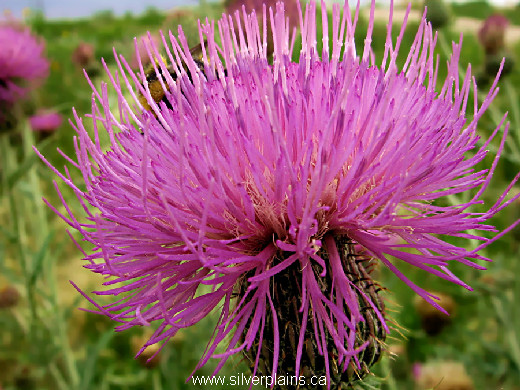
Cirsium Flodmanii

Flodman's thistle - Cirsium Flodmanii 09AU04
Flodman's thistle - Cirsium Flodmanii 07JL08-2
Flodman's thistle - Cirsium Flodmanii 07JL08-1
Flodman's thistle - Cirsium Flodmanii 13AU04
Flodman's thistle - Cirsium Flodmanii 09AU13
Flodman's thistle - Cirsium Flodmanii 12JL26-2
Flodman's thistle - Cirsium Flodmanii 12JL26-1

characteristics

A biennial with long and often singular stems covered with a dense whitish fuzz. However, given room to grow, this plant can become a small bush. Leaves are spiny, deeply toothed, greenish on top, woolly gray underneath. One to five wide flowerheads per stem are also covered with spines. Tube shaped flowers are deep pink (magenta) to purple. Seeds are tufted with long bristles. Spreads by rhizomes which become taproots on new plants.

A member of the sunflower family. Very photogenic.

T SSN H W sun soil H2O fire N2 pH summer fall flower (seed)
B CW-Y 0.9 0.1 S F-M-C M •• - - silver silver magenta

habitat

Fields, pastures, hills and coulee bottoms.

uses

Very popular plant. American goldfinches love the seed. Bees, butterflies, hoverflies, hornets, and beetles like the flowers a lot. Small insects are sometimes caught in a sticky secretion on the flowers.

North American aboriginals ate the peeled stems.

Comments (5)

  • Shelley Malyk

    I am a resident of Winnipeg and I'm transitioning my lawn and garden to prairie native species from Manitoba. I am having trouble finding seed for growing Flodman's Thistle. I have searched all the Canadian growers I can find without success. I wonder if you might have a few seeds available for purchase?

  • Robert Mears

    Hi Shelley,
    We don't have any seed at present. Perhaps, when it warms up a bit, I can check the plants in the yard for seed. There are several stems still standing.

  • Shelley Malyk

    Thanks so much Robert! I really appreciate your help with my plans! There’s no hurry for getting them.

  • Shelley Malyk

    I hope your land and your planting survived this spring's flooding. Just a quick check in and to let you know if your piece of prairie experienced damage and needs some seed donations of native species, my garden may be able to provide some in the fall. It's in year 2 of transforming lawn to native plants, but some of the plants are ready for sharing.

  • Robert Mears

    Thanks for the query and offer, Shelley,
    It was a peculiar spring for us in that all the water outside of the ring dike did not affect us personally. However, all of the snow inside the dike made for a very wet yard when it melted. The wet start plus all the moisture since has meant that a lot of seed has germinated. Much of it native.
    I'd like to say we can collect some Flodman's thistle seed for you but the lack of insects this year may mean little or no seed. We must wait and see.

Leave your comments

0 Character restriction
Your text should be more than 100 characters
common > name = have on site
T = type: A = annual | B = biennial | P = perennial | SS = subshrub | D = deciduous | C = coniferous
██ = cold stratify | ██ = cold stratify & scarify | ██ = plant directly | ██ = scarify | ██ = not from seed
SSN = season: C = cool | W = warm | Y = late
H = height (in metres) | W = width (in metres) | B = bunch | S = sod | SB = sod/bunch
sun: S = full sun | S/PS = sun or partial shade | PS = partial shade | SH = full shade
soil: F = fine | M = medium | C = coarse
H2O = moisture requirement: D = dry | M = moist | W = wet | Z = aquatic
fire = fire tolerance: - = unknown | X = none | = some | •• = moderate | ••• = high tolerance
N2 = nitrogen fixing: = yes
summer = foliage colour | fall = foliage (stem) colour | flower (seed) = flower (seed / fruit) colour, if conspicuous
pH = acidity - alkalinity