Juncus balticus Willd.



characteristics
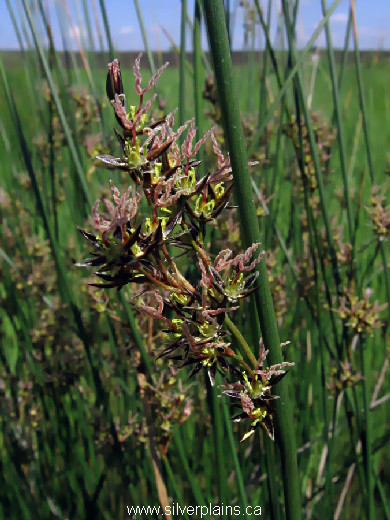
Upright stems are dark-green, wiry and round. Numerous (10 - 50) tiny brown flowers with bright pink stigmas grow in panicles. Fruit is a beak-like chamber containing numerous seeds. Often found growing in rowed clumps. Roots may reach 40 cm in depth.
One of the more common rushes in this part of the world. Also known as wire rush and some sources, including the USDA, use the Latin name Juncus arcticus for this plant.
3,000,000 seeds/pound; starts from seed, sprig, cutting.
| T | SSN | H | W | sun | soil | H2O | fire | N2 | pH | summer | fall | flower (seed) |
|---|---|---|---|---|---|---|---|---|---|---|---|---|
| P | CW-W | 1.0 | S | S/PS | F-M | W | ••• | x | 6.0-9.0 | green | grey | brown |
habitat
Wet meadows, marshes, edges of lakes, ponds, streams, and other riparian areas.
uses
Cover and seed source for waterfowl, songbirds and small mammals.
Seeds used for food, stems for basket weaving by some North American aboriginals. A sugar formed at the top of the plant was eaten as candy; a fermented drink was made from the stems.
Excellent for reconstructed wetlands:
Removes Nitrogen (N2) and phosphorus (P) from water.

Comments